

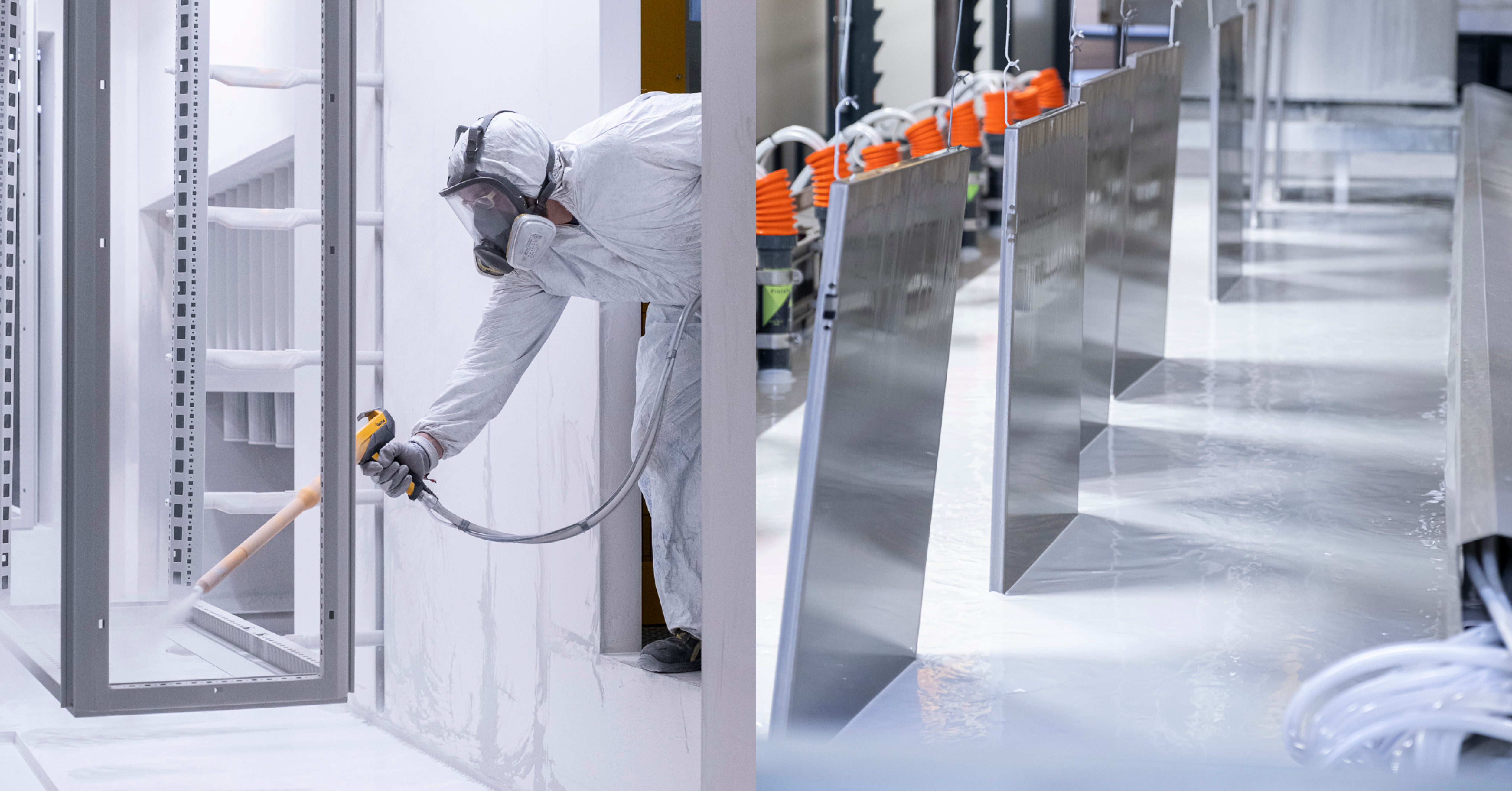
In industrial automation, the surface treatment of the sheet metal determines the actual longevity of an electrical cabinet and the reliability of its internal hardware. In environments subject to chemical exposure, moisture, or harsh atmospheric conditions, the surface finish is not a matter of aesthetics, but an essential engineering shield against corrosion.
The comparison between cataphoresis and powder coating is often framed as a choice between two alternative processes. However, to properly evaluate the effectiveness of a coating, it is necessary to analyze how the protective film behaves on the geometrically critical points of the metallic structure.
Powder Coating: standard protective barrier
Powder coating relies on the electrostatic application of thermosetting resins, cured in a high-temperature oven. This finish guarantees an excellent protective barrier across the external surface, superior scratch resistance, and long-term color stability.
- Recommended use: This is the ideal and most effective solution for indoor electrical cabinets and metalwork installed in dry or moderately humid environments (ISO 12944 classes C1 to C3 Indoor).
- Technical limitation: Since it relies on a spray application, it is subject to the physical phenomenon known as the "Faraday cage effect." The electric field lines struggle to reach deeper recesses, making it difficult to ensure a uniform film on sharp edges, right angles, or inside the hollow profiles that form the cabinet.
Cataphoretic coating: full-surface electrodeposition
Cataphoretic coating addresses this geometric vulnerability at its root. This method operates via full immersion in electrochemical tanks, allowing the epoxy primer to cover every square millimeter uniformly.
- Recommended use: This becomes a crucial step for cabinets installed outdoors, in harsh industrial environments, or in high-humidity indoor settings up to ISO C4 class.
- Core benefits: The principle of electrical attraction ensures that the protective film reaches tight gaps and internal hollow sections that would otherwise be inaccessible. This guarantees uniform coverage even on sharp edges, which are traditionally the primary starting points for rust.
The power of tailored technical consulting and customization
Overall, while standard powder coating perfectly meets the needs of indoor electrical enclosures, cataphoresis serves as an essential protective barrier when enclosures are exposed to weathering or harsh chemicals.
However, application limits are never fixed. Each operating environment presents unique challenges: chemical stress in a petrochemical facility, thermal swings in desert installations, or aggressive washdowns on a food production line all require targeted calibration of coating thickness and resin types.
Frequently, the right solution is not a drastic choice between one process or the other, but rather a combination of both.
Surface protection directly impacts how long automation systems will last. Working hand-in-hand with system designers right from the start, Zanardo evaluates the exact environmental factors and physical requirements of the installation site to configure the ideal coating combination and custom modifications for each project.
Get in touch with our technical team—together, we can analyze the specific needs of your installation: www.zanardo.com/en